Class 10 · Mathematics · New NCERT
NCERT Solutions for Class 10 Mathematics Chapter 1: Real Numbers
Chapter 1 revisits the properties of real numbers built up in earlier classes and extends them with two central results: Euclid's Division Lemma and the Fundamental Theorem of Arithmetic. Together these tools are used to find the HCF and LCM of integers, and to reason about when a rational number has a terminating or a non-terminating repeating decimal expansion.
Chapter overview
- Euclid's Division Lemma
- Euclid's Division Algorithm
- The Fundamental Theorem of Arithmetic
- HCF and LCM by prime factorisation
- Revisiting irrational numbers
Chapter Overview
This chapter builds two ideas on top of the number system studied in earlier classes: Euclid's Division Lemma, and the Fundamental Theorem of Arithmetic. Both are used repeatedly across the exercises below.
Euclid's Division Lemma
Given positive integers a and b, there exist unique whole numbers q and r satisfying a = bq + r, where 0 ≤ r < b.
Exercise 1.1
Q1. Use Euclid's division algorithm to find the HCF of 135 and 225.
Answer
Since 225 is larger than 135, apply the division lemma to 225 and 135.
Steps
- Apply Euclid's division lemma to 135 and the remainder 90.
- 135 = 90 × 1 + 45
- Apply the lemma again to 90 and the new remainder 45.
- 90 = 45 × 2 + 0
- The remainder is now zero, so the algorithm stops here.
The divisor at the final step, where the remainder became zero, is the HCF.
Q2. Show that any positive odd integer is of the form 6q + 1, 6q + 3 or 6q + 5, where q is some integer.
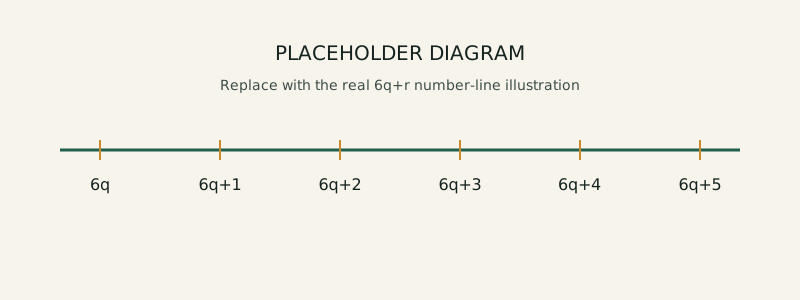
Image unavailable. Open original
Number line marking integers of the form 6q, 6q+1, 6q+2, 6q+3, 6q+4 and 6q+5
Answer
Let a be any positive integer and b = 6. By Euclid's division lemma, a can be written as:
so r can only be 0, 1, 2, 3, 4 or 5, giving the six possible forms 6q, 6q+1, 6q+2, 6q+3, 6q+4 and 6q+5.
| Form | Parity |
|---|---|
| 6q | Even |
| 6q + 1 | Odd |
| 6q + 2 | Even |
| 6q + 3 | Odd |
| 6q + 4 | Even |
| 6q + 5 | Odd |
Removing the three even forms leaves exactly 6q + 1, 6q + 3 and 6q + 5 as the possible forms of an odd positive integer.
Exercise 1.2
Fundamental Theorem of Arithmetic
Every composite number can be expressed as a product of primes, and this factorisation is unique apart from the order in which the prime factors occur.
Q1. Express 156 as a product of its prime factors.
Answer
Steps
- 156 = 2 × 78
- 78 = 2 × 39
- 39 = 3 × 13
- 13 is prime, so the factorisation stops here.
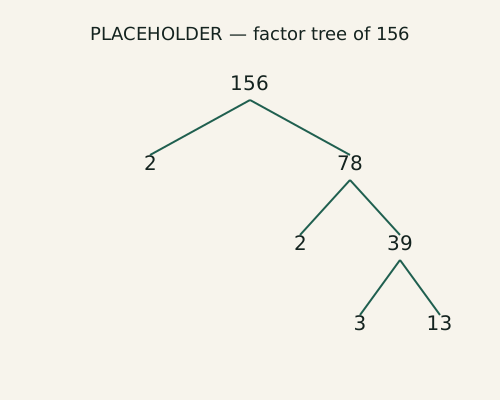
Image unavailable. Open original
Factor tree showing 156 broken down into 2, 2, 3 and 13
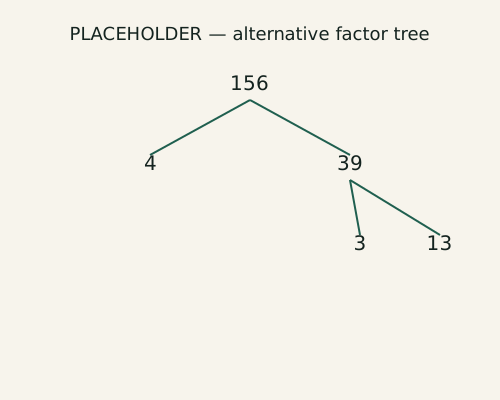
Image unavailable. Open original
Alternative factor tree arriving at the same prime factorisation
Exercise 1.3 — Irrational Numbers
Q1. Prove that √5 is irrational.
Proof
Assume, for contradiction, that √5 is rational. Then √5 = p/q for coprime integers p and q with q ≠ 0. Squaring gives p² = 5q², so 5 divides p², and hence 5 divides p. Writing p = 5c and substituting back gives q² = 5c², so 5 divides q as well. This contradicts p and q being coprime, so the assumption is false and √5 is irrational.
Rational numbers
Can be written as p/q with q ≠ 0; decimal expansion terminates or repeats.
Irrational numbers
Cannot be written as p/q; decimal expansion neither terminates nor repeats.
A rational number's decimal expansion is terminating or non-terminating repeating; every other real number is irrational.
- HCF × LCM = product of the two numbers (only for two numbers, not three or more)
- Every composite number has a unique prime factorisation
- √p is irrational for every prime p